
Home
Portfolio
Company
Contact
 Stride Forward Group
February 2025 - Ongoing
Saas and Tech
South Africa




Stride is a digital media management platform that helps music industry professionals organize and maintain detailed information about musicians, albums, and associated metadata. Their internal application centralizes artist-related data, streamlining operations for cataloging, updates, and reporting across music portfolios.

Fully Automated Schema & Data Migration Pipeline
Foreign Key–Aware Loading with Insert Ordering
User-friendly dashboards with full operational visibility

Data Engineers
Python Developers
Database Migration Specialists
DevOps Support Engineers

Contract on hourly basis
Eliminating Data Gaps, Inefficient Reporting, and Weak Customer Understanding

SQL Server’s .bak format restricted the use of standard ETL pipelines and required custom extraction logic.
.png)
Dozens of foreign-key–linked tables introduced risk of referential mismatches during migration.

Client required re-runnable, partial migrations without duplicate insertions or data corruption.
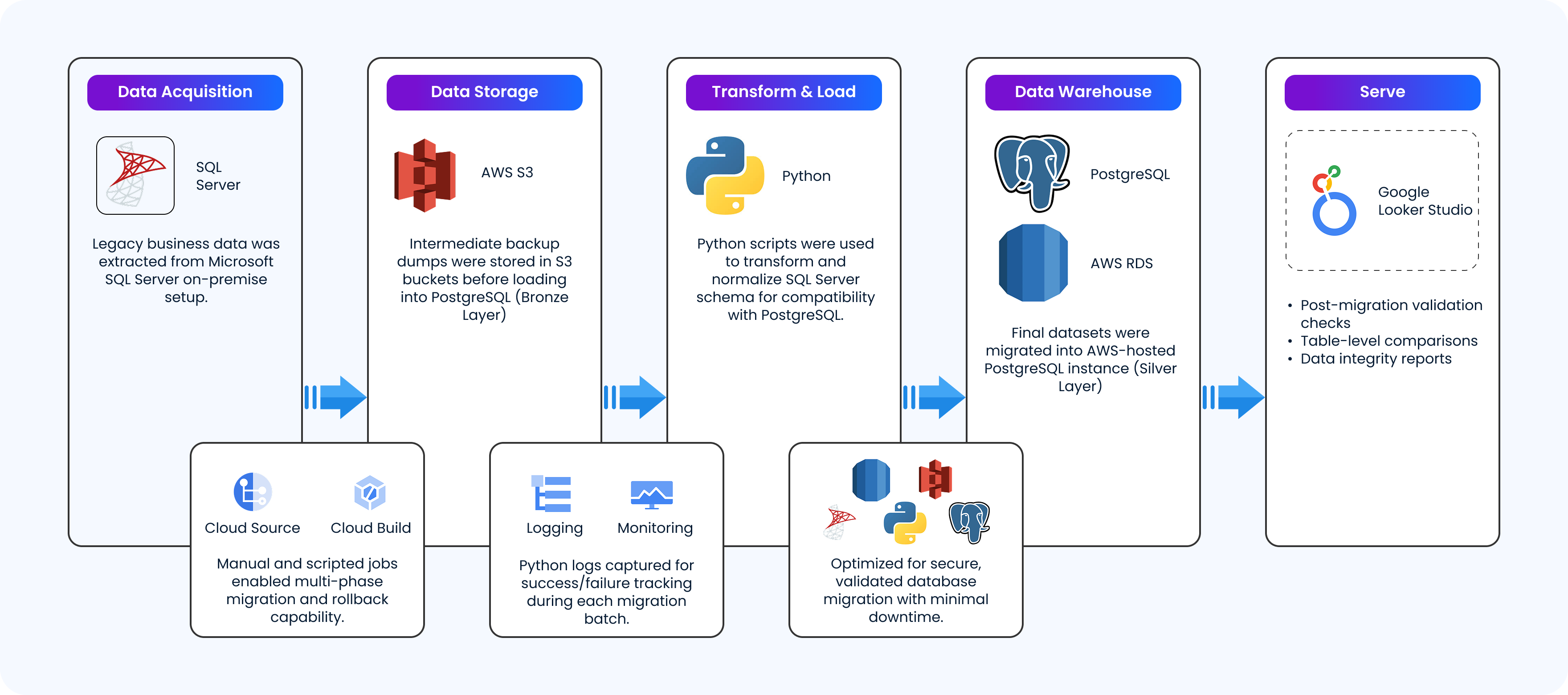
The project began with schema introspection from the SQL Server .bak backup, reconstructing PostgreSQL-compatible DDL using Python scripts. Pandas DataFrames were used to extract, inspect, and transform table data for loading. A two-phase migration plan was adopted—first loading dimension tables, capturing their new primary keys, and then loading dependent fact tables by resolving foreign keys dynamically. The system included row-level comparison logic to ensure that any remigrations were idempotent and skipped already-migrated records.
Strategic questions that informed the approach:
How do we replicate schema while adapting SQL Server DDL to PostgreSQL conventions?
What method ensures foreign key resolution even when auto-incremented IDs change?
How can we support repeated or partial migrations without introducing duplicates?
What loading order preserves referential integrity across interlinked tables?
Robust, Incremental Migration Framework for Legacy SQL Server Data
To tackle complex legacy migrations, we built Python-based schema introspection scripts that dynamically extracted SQL Server structures and generated PostgreSQL-compatible DDLs. Data was processed in-memory using Pandas, allowing precise row-level transformations and type casting.
The migration framework included deduplication and delta detection, ensuring only new or changed records were inserted.
Automated insert sequencing honored referential integrity by managing primary and foreign key dependencies in memory. This approach enabled safe, incremental migrations without data corruption or duplication, ensuring seamless and repeatable migration across interdependent tables.

.png)



foreign key integrity preserved post-migration

interrelated tables migrated with no manual inserts required
duplicate records after multiple test retruns
faster debugging via in-memory inspection and mapping

DataRopes.ai is a global technology partner which delivers end to end services like data engineering, data analysis, data science and AI & ML
Reviewed on


150 E B St Lbby # 1810

1106 A, 11th floor, Haly Tower,
Sector R DHA Phase 2, Lahore
DataRopes.ai is a global technology partner which delivers end to end services like data engineering, data analysis, data science and AI & ML.
Reviewed on
Address
150 E B St Lbby # 1810
1106 A, 11th floor, Haly Tower,
Sector R DHA Phase 2, Lahore
© DataRopes 2025. All rights reserved


.png)

.png)
