
Home
Portfolio
Company
Contact
 SupeRadar
March 2025 - Ongoing
E commerce and retail
North America

%202.png)

.png)

Superadar is a competitive intelligence company focused on retail pricing analytics. By aggregating product pricing data from major supermarket chains like Walmart, Superadar enables brands and retailers to monitor market trends, compare competitor pricing, and make data-driven pricing decisions. Their platform supports both historical and real-time price tracking to empower smarter retail strategies.

Centralized Data Warehouse for Crawled Data
Automated ETL Pipeline for Future Crawl Files
Manual UUID Mapping Interface via Google Sheets
Price Trend and Competitive
Intelligence Dashboards

Data Engineers
Python Developers
BI Analysts
Workflow Automation Specialists

Fixed Project
Eliminating Data Gaps, Inefficient Reporting, and Weak Customer Understanding

Crawled pricing data existed only in scattered Excel files with inconsistent structure.

Product identity across retailers was unstructured, blocking trend analysis and matching.
.png)
Delays in integrating crawl files made it impossible to maintain up-to-date analytics.
The project began by building a centralized BigQuery warehouse to ingest and normalize all historical Excel-based crawled data. Python scripts were created to clean inconsistent formats, extract relevant fields, and manually map UUIDs to each product.To support fresh crawl data, the vendor transitioned to pushing files directly into sharded BigQuery tables. This enabled the creation of scheduled queries and stored procedures that performed automatic table detection, schema checks, and merge operations. For UUID mapping of new products, a user-friendly Google Sheet interface was developed. This allowed the client to manually assign UUIDs, and trigger a backend App Script to push those mappings directly into BigQuery, seamlessly feeding the downstream analytics pipeline.
Strategic questions that guided development included:
● How can we standardize product identity across retailers with inconsistent naming?
● What automation minimizes manual handling of recurring data drops?
● How do we balance structured UUID mapping with user-friendly tools?
● What architecture supports long-term trend analysis and comparison at scale?
Automated Price Intelligence Pipeline with Unified Data Mapping
To resolve fragmented and outdated pricing analytics, we built a robust pipeline to centralize, clean, and analyze product pricing data. Legacy Excel files were parsed using Python scripts to normalize historical data and ingest it into BigQuery.
Automated ETL triggers—powered by stored procedures and scheduled queries—processed incoming data pushed by external vendors. A Google Sheets interface enabled manual UUID assignment, with App Scripts syncing updates back to BigQuery for structured product identity.
Finally, Looker Studio dashboards were built on this standardized data layer, providing dynamic, accurate insights into pricing trends and retailer comparisons at scale.
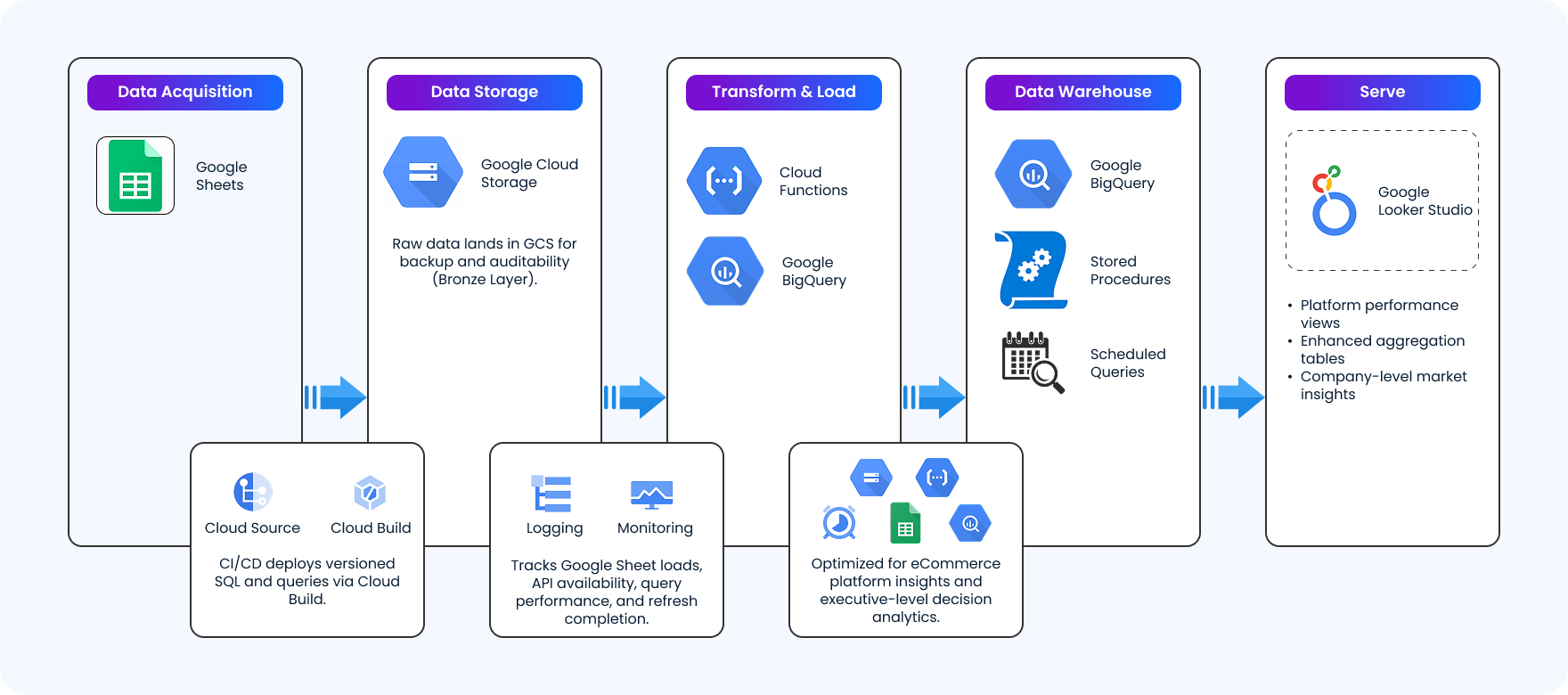
.png)
.png)



product rows standardized across multiple supermarkets

reduction in manual data preparation time
of pricing reports now generated through real-time Looker Studio dashboards
of new product entries assigned UUIDs via Google Sheets workflow

DataRopes.ai is a global technology partner which delivers end to end services like data engineering, data analysis, data science and AI & ML
Reviewed on


150 E B St Lbby # 1810

1106 A, 11th floor, Haly Tower,
Sector R DHA Phase 2, Lahore
DataRopes.ai is a global technology partner which delivers end to end services like data engineering, data analysis, data science and AI & ML.
Reviewed on
Address
150 E B St Lbby # 1810
1106 A, 11th floor, Haly Tower,
Sector R DHA Phase 2, Lahore
© DataRopes 2025. All rights reserved


.png)

.png)
